
Distracted Parenting: What Your Phone Use Does to Your Kids
Updated: Sep 23
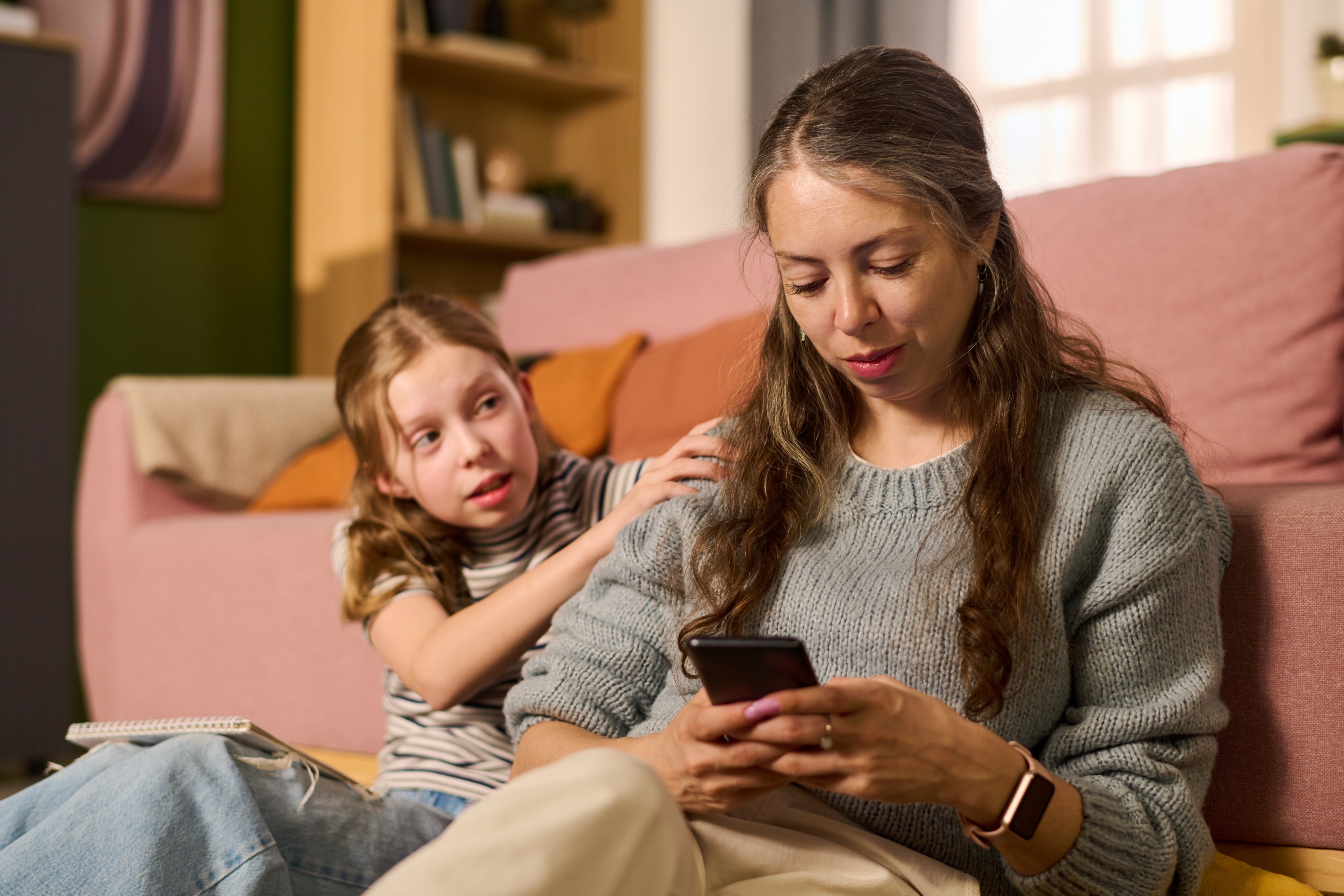
You know how much energy we spend haggling over our kids' screen time? Last week I posted a TikTok suggesting we turn some of that attention toward our own screens, and it took off. The comments came in fast. Most parents agreed that distracted parenting is a real problem, and that a child's mental health isn't just about the child's phone use. It's also about ours. Maybe even more so.
But two questions kept coming up. Where's the research? And how are we supposed to limit our own phone use when the phone runs everything from the school portal to the parking meter?
Fair questions. Let's take them one at a time.
What the Research Says About Distracted Parenting
Researchers Brandon McDaniel and Jenny Radesky have a name for what happens when a phone interrupts time with our kids: technoference. Their research shows those small, everyday interruptions add up. In one study of 170 families, more technoference during parent-child time was linked to more behavior problems in young kids, both the “acting-out” kind and the anxious, withdrawn kind.
A follow-up study found that the cycle runs both ways. Kids act out more, parents feel more stressed, and stressed parents retreat to their phones, which leads to more acting out. Nobody is doing this on purpose. Distracted parenting is just an easy loop to fall into.
There's also a well-known observational study where researchers quietly watched caregivers and kids eating at fast food restaurants. Most of the adults used their phones during the meal. The most absorbed adults were slower to respond to their kids and reacted more harshly when they finally did.
Why does this matter so much? Young kids build their sense of safety through back-and-forth with us. This is called coregulation, which is a fancy way of saying kids borrow our calm. When a child looks up and finds a face that's locked on a screen, that face reads as absent or even hostile.
Phones Are New. How Do We Already Know They Hurt Kids?
Some commenters pushed back in a fair way. Smartphones have only been around since 2007, so how can anyone claim they lead to worse mental health in kids? Don't studies like that take decades?
Here's the simple version. Scientists knew for more than fifty years that kids struggle when their parents consistently check out. Research going back to the 1970s shows that when a caregiver's face goes blank and unresponsive, babies get distressed within seconds and work hard to win the attention back. Inattentive parenting was tied to poor child outcomes long before anyone owned an iPhone.
What's new is the evidence that phones reliably produce that kind of checked-out attention. That's what the technoference studies measure. So researchers aren't starting from scratch. The phone is just a new road to a problem we already understood.
And now direct evidence is arriving too. A 2025 meta-analysis in JAMA Pediatrics pooled 21 studies of nearly 15,000 young children in 10 countries. It found that parents' technology use around their kids was linked to poorer thinking skills, more emotional and behavioral struggles, weaker attachment, and more screen time for the kids themselves. That last one matters. Our phone habits and theirs appear to be tangled together.
Isn't This Just the New Version of Reading the Newspaper?
I hear this one a lot. Our parents disappeared behind the sports section every morning, and we all survived. But a phone is different in two ways that matter.
When your dad was behind the newspaper, you knew exactly what he was doing. And he might grumble about the White Sox or the new stadium construction project. That mattered in how you learned about your family. But your phone is invisible. When you're on your phone, your kid has no clue what you’re doing.
You could be checking the weather, canceling their playdate, or reading bad news about a relative. Kids' brains have a negativity bias, as we all do, which means their minds tend to assume the worst when they don't know what's going on. So their imagination fills the gap, and it usually fills it with something scary.
Second, a phone physically narrows your gaze. Your eyes lock onto a space about the size of your palm. Your peripheral vision stops picking up the little signals your kid sends, like the quick glance to check whether you saw their super high jump. A newspaper spreads your view wider, so a parent behind the paper could still catch those cues over the top of the page.
Why Limiting Your Phone Use Feels Impossible
The parents in my comments weren't wrong. The phone is the camera, the calendar, the school portal, the map, the grocery list, and the way you pay for parking. You can't just throw it in a lake.
And I'm not writing this from some peaceful phone-free mountaintop. Last week I was editing a photo of my kid while my actual kid was standing next to me asking a question. So we're all learning about distracted parenting here.
The goal isn't zero phone use. It's making your phone use visible and predictable instead of mysterious. Kids can handle a parent who needs the phone for a few minutes. What's hard on them is a parent who disappears into it with no warning and no end.
But Don't I Deserve Some Scroll Time?
Yes. Yes, you do. A lot of parents in the comments said some version of "I deserve time on my phone, and my kid does not need my attention every waking minute." Both of those things are true. Kids don't need a parent hovering over every block tower, and constant attention isn't even good for them.
What matters in preventing distracted parenting is the pattern over time. Your child needs to learn that you're reliable, and that when they reach for you, you'll respond with warmth more often than not. A parent who scrolls for a stretch after being genuinely present all afternoon is teaching a kid something very different than a parent who is half-there all day.

So structure it on purpose. Build time into your day when you get to sit and scroll and chill. The awareness piece is simply knowing what heavy, unpredictable phone use does over time, and deciding intentionally where your phone time goes, and what it’s for, instead of letting it leak into everything.
One more thing worth knowing: kids watch how we handle boredom and stress. If our phone comes out every time we’re waiting in line or feeling frazzled, we're teaching our kids that's what a person does with an uncomfortable moment. Practice letting your kid catch you calming down or entertaining yourself without a screen, maybe with a stretch, or just staring out the window like it's 1995. That might take a little practicing, and that's fine. Kids are practicing too.
Less Distracted Parenting: Boundaries and Connection
In our Olley program, we teach parents two skills that apply directly here: establishing and enforcing boundaries and leading with connection. Your phone is just another place to practice both.
Before you pick up the phone, you might tell your kid what you're doing and how long it will take.
"Hey sweetie, we're going to the park, but while we're there I need to be on my phone for a minute because I'm emailing your teacher about the field trip." Then enforce the boundary you set.
When the email is sent, the phone goes away and you say so. "Okay, phone's away. Teacher knows about the field trip. What did I miss?"
Saying it out loud does a lot of work. Your child learns the phone has a purpose and an ending. Nobody is left guessing whether your serious face means something bad happened. It also keeps you honest, because a boundary you announced is much harder to blow past than one you kept to yourself.
Keeping Boundaries
Boundaries with technology can be small and still count. At restaurants, ask for a paper menu instead of scanning the QR code. Pick one stretch of the day, maybe dinner or the walk home from school, where the phone stays tucked in a pocket. Hold that line even when it buzzes.
Leave it across the room at home, because a phone out of arm's reach gets checked far less than a phone in your pocket. And maybe the easiest and most effective move is to turn off notifications for anything that isn't a human who needs you, since every buzz is an invitation to disappear for a second.
Leading with Connection
Leading with connection is the other half. The relationship gets your best attention first, and the phone fits in around it. Even a few minutes of real, undistracted time before you step away changes how your phone time lands, because your kid isn't competing with the screen for you.
None of this requires becoming a different person. It just means deciding ahead of time when the phone comes out, instead of reaching for it on autopilot.
Ready to Build Your Parenting Skills?
If you'd like more practical, judgment-free ways to build these skills, our Olley program teaches parents exactly this, from leading with connection to establishing and enforcing boundaries around technology. You can find us at olleyolley.com.


Comments